Improving Cleanroom Reliability in TCU Applications
A success case on reducing condensation risks and improving operational control in Biopharma environments
In Biopharma and Biotech manufacturing, precise temperature control is a key process factor. From mixing and formulation operations to particularly sensitive production stages, maintaining temperature within defined ranges is essential to ensure product quality, process safety, and batch-to-batch consistency.
Temperature Control Units (TCUs) play a central role in achieving this stability. They are carefully selected, validated, and integrated into production environments where reliability is non-negotiable. However, despite this focus on the main equipment, one element often remains underestimated—even though it has a direct impact on daily operations: the flexible connections between the TCU and the process equipment.
This article explores why that final section of the thermal loop can become a critical point in cleanroom environments, and how it should be approached from a technical and operational perspective.
The role of TCUs in Biopharma processes
TCUs are used to regulate the temperature of jacketed process equipment, such as mixers, reactors, and vessels, by circulating a thermal fluid through the jacket.
In Biopharma and Biotech applications, the most common fluids are:
- Chilled water.
- Water–glycol mixtures (often referred to as brine).
These fluids typically operate in the 4 to 8 °C range, especially in processes where thermal stability directly affects product behavior, reaction kinetics, or product integrity.
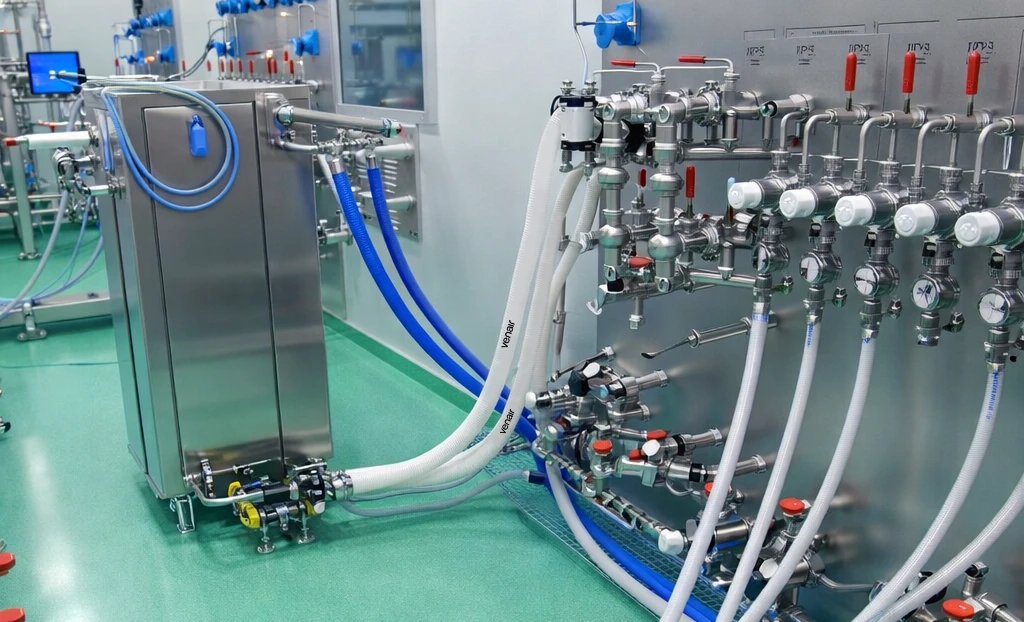
The connection between the TCU and the process equipment is usually made via flexible hoses, which provide several functional advantages: vibration absorption, easier installation, and the ability to adapt to different layouts, skid configurations, or single-use setups.
The real environment: cleanrooms and high humidity
The real challenge appears when these flexible connections operate inside cleanroom environments.
In such settings:
- Ambient humidity levels are intentionally controlled but often high.
- Environmental conditions are tightly regulated under GMP.
- Any uncontrolled presence of water can quickly become an operational, quality, or safety concern.
When a cold fluid circulates through a hose in a humid environment, a predictable physical phenomenon occurs: condensation.
Condensation as an operational issue
Condensation forms when the external surface temperature of the hose drops below the ambient dew point
In practical terms, this leads to:
- Water droplets forming on the hose surface.
- Dripping onto floors or nearby equipment.
- Persistently damp areas around connection points.
While this may initially appear minor, in Biopharma environments it creates tangible consequences:
- Hygienic risks in cleanroom áreas.
- Increased corrective cleaning activities, often outside planned routines.
- Safety risks caused by slippery surfaces.
- Concerns raised by Quality Assurance (QA) teams.
- Disruptions that reduce overall operational efficiency.
In many cases, the thermal control system itself performs exactly as intended, but the flexible connections become the weak link in the system.
Why standard hoses are not sufficient
Standard industrial hoses are typically designed to meet core requirements such as pressure rating, chemical compatibility, and basic flexibility. However, they are not engineered to operate in high-humidity environments while carrying low-temperature fluids, which is precisely the scenario found in Biopharma cleanrooms.
Common limitations include:
- Lack of effective thermal insulation.
- Outer surfaces that encourage condensation formation.
- Increased weight when improvised insulation is added.
- Difficult handling in suspended, overhead, or mobile installations.
This highlights a critical point: the application does not require a modified standard hose, it requires a solution designed specifically for the operating conditions.
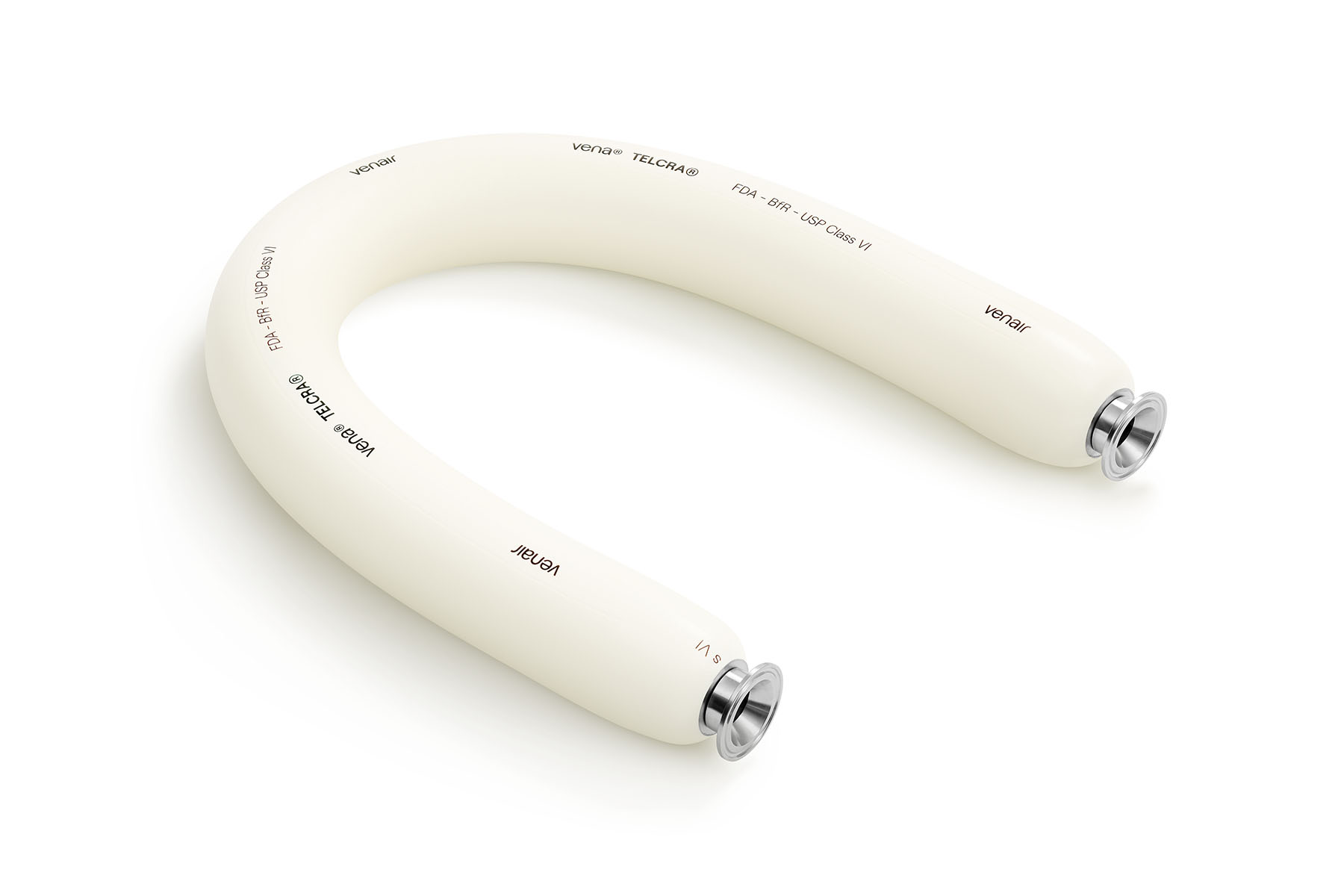
For this reason, the connection system itself becomes a key part of the solution. Rather than relying on a standard hose, the application requires a hose configuration specifically engineered for low-temperature operation in high-humidity cleanroom conditions.
In this context, VENA® TELCRA INSULATION COVER provides a solution aligned with the requirements described in this application. By integrating thermal insulation directly around the hose assembly, the system limits surface cooling and significantly reduces the risk of condensation when circulating chilled water or water–glycol mixtures.
An effective solution for TCU connections in Biopharma should therefore include:
- Integrated thermal insulation, provided directly on the hose assembly, limiting surface temperature drop and avoiding additional layers that could become a contamination focus.
- An anti-condensation outer layer, suitable for sustained high-humidity cleanroom environments.
- Lightweight construction, especially important for ceiling-mounted or suspended routing.
- High flexibility simplifying installation, maintenance, and equipment movement.
- Secure, repeatable connections, such as quick couplings or sanitary clamp fittings
- Pre-assembled hose assemblies, delivered ready to install and minimizing on-site handling
Installation practices also play a role. For example, avoiding continuous contact between hoses or surfaces helps preserve anti-condensation performance over time.
A recurring scenario in real-world facilities
This challenge is not theoretical. In real Biopharma and Biotech plants, particularly in CDMO environments and single-use processing, condensation on TCU connections is a recurring issue.
When addressed correctly, facilities typically observe:
- Drier, more controlled production areas with improved cleanliness through effective moisture control.
- Reduced unplanned cleaning workload.
- Improved cleanroom safety.
- Greater confidence from Production and QA teams.
- More stable, predictable daily operations.
These improvements may seem incremental, but together they significantly enhance overall process robustness.
Conclusion
In Biopharma manufacturing, thermal control does not stop at the TCU.
Flexible connections are an integral part of the system and must be designed with the real operating environment in mind.
By applying a solution such as VENA® TELCRA® INSULATION COVER, specifically engineered for TCU applications in cleanroom environments, condensation can be addressed directly at the connection level. This approach enhances hygiene, safety, and operational stability without necessitating modifications to the TCU or core process equipment.
Addressing condensation at the hose design level is therefore a technical decision that directly impacts cleanroom reliability and overall process robustness, transforming a recurring operational issue into a controlled, engineered solution aligned with modern Biopharma and Biotech requirements.