
Condensation calculator
Enter the conditions of your installation — liquid temperature, room temperature and humidity — and see whether your cold line will condense and whether Vena® TELCRA keeps it dry.
Calculate
Liquid −15 to 0 °C · air 15 to 30 °C · humidity 40 to 95 %
No condensation
- Dew point of the air
- 12.9 °C
- Margin over dew point
- 5.6 °C
- Telcra surface
- 18.5 °C
The Telcra surface stays at 18.5 °C, 5.6 °C above the dew point. At these temperatures it would not condense below 86 % relative humidity.
The lab test
The Telcra surface, measured with liquid from −15 to 0 °C.
650V silicone tube with a 16 ± 2 mm layer of Vena® TELCRA, in a room at 20–22 °C. Inside, the liquid drops by 15 °C; outside, the surface drops by only 2.5 °C.
| Liquid °C | Telcra surface °C | Difference °C |
|---|---|---|
| −15 | 17.75 | 32.75 |
| −12.5 | 17.90 | 30.40 |
| −10 | 18.50 | 28.50 |
| −7.5 | 18.80 | 26.30 |
| −5 | 19.61 | 24.61 |
| −2.5 | 19.88 | 22.38 |
| 0 | 20.29 | 20.29 |
Dew point chart
Dew point chart (°C) by air temperature and humidity.
In °C, from the Magnus formula. Any surface colder than the value in its cell gets wet: a pipe, a hose, a window or a wall.
| Air \ RH | 30 % | 40 % | 50 % | 60 % | 70 % | 75 % | 80 % | 85 % | 90 % | 95 % |
|---|---|---|---|---|---|---|---|---|---|---|
| 0 °C | −15.5 | −12.0 | −9.2 | −6.8 | −4.8 | −3.9 | −3.0 | −2.2 | −1.4 | −0.7 |
| 5 °C | −11.2 | −7.5 | −4.6 | −2.1 | 0.0 | 0.9 | 1.8 | 2.7 | 3.5 | 4.3 |
| 10 °C | −6.8 | −3.0 | 0.0 | 2.6 | 4.8 | 5.8 | 6.7 | 7.6 | 8.4 | 9.2 |
| 12 °C | −5.1 | −1.2 | 1.9 | 4.5 | 6.7 | 7.7 | 8.7 | 9.6 | 10.4 | 11.2 |
| 14 °C | −3.3 | 0.6 | 3.7 | 6.4 | 8.6 | 9.6 | 10.6 | 11.5 | 12.4 | 13.2 |
| 16 °C | −1.6 | 2.4 | 5.6 | 8.2 | 10.5 | 11.6 | 12.6 | 13.5 | 14.4 | 15.2 |
| 18 °C | 0.2 | 4.2 | 7.4 | 10.1 | 12.4 | 13.5 | 14.5 | 15.4 | 16.3 | 17.2 |
| 20 °C | 1.9 | 6.0 | 9.3 | 12.0 | 14.4 | 15.4 | 16.4 | 17.4 | 18.3 | 19.2 |
| 21 °C | 2.8 | 6.9 | 10.2 | 12.9 | 15.3 | 16.4 | 17.4 | 18.4 | 19.3 | 20.2 |
| 22 °C | 3.6 | 7.8 | 11.1 | 13.9 | 16.3 | 17.4 | 18.4 | 19.4 | 20.3 | 21.2 |
| 23 °C | 4.5 | 8.7 | 12.0 | 14.8 | 17.2 | 18.3 | 19.4 | 20.3 | 21.3 | 22.2 |
| 24 °C | 5.4 | 9.6 | 12.9 | 15.8 | 18.2 | 19.3 | 20.3 | 21.3 | 22.3 | 23.1 |
| 25 °C | 6.2 | 10.5 | 13.9 | 16.7 | 19.1 | 20.3 | 21.3 | 22.3 | 23.2 | 24.1 |
| 26 °C | 7.1 | 11.4 | 14.8 | 17.6 | 20.1 | 21.2 | 22.3 | 23.3 | 24.2 | 25.1 |
| 28 °C | 8.8 | 13.1 | 16.6 | 19.5 | 22.0 | 23.2 | 24.2 | 25.2 | 26.2 | 27.1 |
| 30 °C | 10.5 | 14.9 | 18.4 | 21.4 | 23.9 | 25.1 | 26.2 | 27.2 | 28.2 | 29.1 |
| 32 °C | 12.3 | 16.7 | 20.3 | 23.3 | 25.8 | 27.0 | 28.1 | 29.2 | 30.2 | 31.1 |
| 35 °C | 14.8 | 19.4 | 23.0 | 26.1 | 28.7 | 29.9 | 31.0 | 32.1 | 33.1 | 34.1 |
| 40 °C | 19.1 | 23.8 | 27.6 | 30.8 | 33.5 | 34.7 | 35.9 | 37.0 | 38.0 | 39.0 |
Dew point: Magnus formula with the Alduchov and Eskridge coefficients (1996), error below 0.1 °C between −40 and 50 °C. Telcra surface: Venair R&D lab test, 650V tube with Telcra at 20–22 °C ambient. An engineering guide, not a certified calculation.
How it works
Three numbers and a 1 °C rule.
-
01
The dew point of the air
From the room's temperature and relative humidity, with the Magnus formula: α = ln(RH/100) + 17.625·T/(243.04 + T) and Td = 243.04·α/(17.625 − α). At 21 °C and 60 %, 12.9 °C.
-
02
The surface temperature
From the R&D lab test: the Telcra surface with the liquid at that temperature, between the seven measured points. It was measured at 20–22 °C ambient; outside that range the same value is used and the result is flagged as approximate.
-
03
The margin
Surface minus dew point. If it is negative, the hose condenses. Between 0 and 1 °C it is borderline: any colder spot, such as a clamp or an uninsulated fitting, condenses first.
-
04
What the calculation leaves out
Draughts, direct sunlight, the uninsulated stretch next to the fittings and metal supports. For a specific installation, our technical team will review your case.
Vena® TELCRA
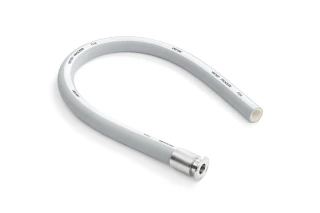
A 16 mm insulating layer over the silicone hose.
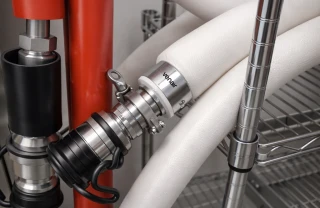
Vena® TELCRA is an insulating sleeve applied over silicone hose on chilled-liquid lines such as glycol or chilled water. With −10 °C inside and the room at 21 °C, the surface stays at 18.5 °C: it does not condense below 85 % humidity. Uninsulated, the silicone stays close to the liquid temperature and condenses at almost any humidity.
See the Vena® TELCRA product page Insulated and heated hoses Condensation in the transport of materials at low temperature
| ID | Tube OD | OD with Telcra |
|---|---|---|
| 6 | 17 | 49 |
| 10 | 21 | 53 |
| 13 | 24 | 56 |
| 19 | 30 | 62 |
| 25 | 36 | 68 |
| 32 | 43 | 75 |
| 38 | 49 | 81 |
| 51 | 62 | 94 |
| 63 | 74 | 106 |
| 76 | 87 | 119 |
| 102 | 113 | 145 |
In mm. OD with Telcra is nominal, ±4 mm (16 ± 2 mm layer).
Questions
What engineers ask about condensation on cold lines.
01 What is dew point temperature?
It is the temperature at which air, cooled without changing its water content, becomes saturated and the vapour starts to condense. Any surface below that temperature gets wet: that is why chilled-water pipes and glycol hoses sweat.
02 How do you calculate the dew point?
With the Magnus formula: α = ln(RH/100) + 17.625·T/(243.04 + T) and Td = 243.04·α/(17.625 − α), with T in °C and RH in %. For example, at 21 °C and 60 % relative humidity the dew point is 12.9 °C. The error is below 0.1 °C between −40 and 50 °C.
03 What is the difference between humidity and dew point?
Relative humidity says how close the air is to saturation at its own temperature; the dew point is the temperature at which it would saturate, so it measures how much water the air actually holds. Air at 21 °C and 60 % has a dew point of 12.9 °C, and any surface colder than that gets wet. Warm the room and the relative humidity drops, but the dew point stays the same.
04 How do you stop condensation on pipes carrying chilled liquid?
Keep the outer surface above the dew point of the room: insulate the line so its surface stays warm, lower the humidity, or both. On silicone hose, an insulating sleeve such as Vena® TELCRA keeps the surface at 18.5 °C with liquid at −10 °C inside and the room at 21 °C. Insulate the fittings and clamps too: they are the first places to sweat.
05 How cold does the Telcra surface get?
In the R&D lab test, at 20–22 °C ambient: 17.75 °C with the liquid at −15 °C, 18.5 °C at −10 °C, 19.61 °C at −5 °C and 20.29 °C at 0 °C.
06 Up to what humidity does a Telcra-insulated hose stay dry?
With the room at 21 °C: up to 81 % with liquid at −15 °C, 85 % at −10 °C, 91 % at −5 °C and 95 % at 0 °C. Above that humidity the surface falls below the dew point.
07 How much margin should I leave between surface and dew point?
At least 1 °C. Room humidity changes during the day, and the cold spots of an installation, such as clamps, fittings and supports, are colder than the hose itself.
08 Does it work for other room temperatures?
The test was run at 20–22 °C ambient, and the calculator always uses the measured surface temperature. Outside that range the result is approximate: for a specific installation, ask our technical team.